We had trouble going live for our conversation last night, but it was recorded!

May 5, 2021

Apr 29, 2021
Join me and Luc Mehl for a Livestream Packraft Conversation
You may have heard about a new packrafting book on the market: The Packraft Handbook by Luc Mehl

Gear review website Treeline Review (and small business owned by two incredible women, friends, and thru-hiking powerhouses: Liz "Snorkle" Thomas, and Naomi "The Punisher" Hudetz) asked me to interview Luc on Tuesday, May 5 to discuss how to get started packrafting.
2 ways to join us:
Facebook Live at the Treeline Review Facebook Page
YouTube Live on the Treeline Review YouTube Channel
So join us!

Apr 16, 2021
SIX MOON DESIGNS’ FLEX PACK REDESIGN
Kirk and I helped redesign the new Flex PR pack this winter, read all about it:

When my partner Kirk and I started packrafting almost 10 years ago, we soon learned one of the biggest challenges in the sport was not the rafting part, although I was on a steep learning curve to becoming a white-water paddler, but actually packing the boat.
The big appeal in packrafting was our new-found ability to walk into more remote rivers and creeks, then launch our boats in places that are inaccessible to vehicles (FYI - Kirk is to rivers as I am to trails, so packrafting combined our most favorite things). Your typical whitewater kayak weighs 45 pounds, and even an inflatable kayak weighs about 35 pounds. Our packrafts weigh closer to 8 pounds (winning!), but when you carry a boat into the backcountry there are other items needed to make your trip safe and successful. Those extra items can be a challenge to pack in a typical backpacking-style pack. On a packrafting trip we usually have: a PFD (life vest), a helmet, throw bag, dry suit, warm layers, paddle, river shoes, dry bags, pin kit (rescue gear), and then all the camping gear: first aid kit, food, water filter, tent, etc. Even when carrying an ultralight backpacking set up for camp, the boats and extra gear combine to make a LOAD, a heavy and cumbersome load.
When Six Moon Designs came out with their Flex pack in 2015 we were stoked to have a better way to carry our gear, and have since then put on the miles. We’ve done several week-long river trips and plenty of weekend hike in/boat out adventures. Over that time we’ve tallied up a list of modifications that would make the Flex pack even more of a power-house. Last year we had a chance to sit down with Whitney at Six Moons to discuss updates to the next generation of portage packs, and we are thrilled with the results.
The Original Flex vs. Flex PR
At first glance, the Flex PR pack looks very similar to the original, minus the fun new color choices (I went red, Kirk chose green), but when we look closer, the features have been modified in ways that provide much more versatility and flexibility. What does that mean for you? More options for fit and comfort.
Exterior Panel
The complete redesign of the exterior panel of the Flex PR has loads of improvements:
1. Width of the panel: The front panel is roughly 3 ½” wider, which translates into better load stabilization, which in turn allowed the front mesh pocket to be bigger, but more about that in the next paragraph. The wider exterior panel means the straps that go across the top to clip to the back panel are also wider. Imagine carrying a bear canister into a remote wilderness river in Montana, the wider those top straps are apart, the better that canister stays securely strapped down. We found it fits a boating helmet better too. Finally, the bottom portion of the bag (which holds all of your gear in place) is also wider - again, providing more surface area to contain the various items you may be carrying.
2. Front pocket improvements:The new double pocket is a game changer! I previously struggled to find a secure place to store my four-piece whitewater paddle, but the pleated pocket behind the existing mesh zipper pocket has changed all that. Place for paddle, check! And because the pocket is now pleated, the front mesh pocket can be used even when the other pocket is maxed out. On a recent trip I had both pockets full, and was able to easily get in and out of the zipper portion. The front pocket is 3” taller, and features the same bungee cord configuration as on the original Flex, a bungie that helps you attach even more odds and ends (did we mention packrafting isn’t exactly ultralight?) as desired.
3. Daisy chains:We love daisy chains! The addition of webbing along the entire exterior panel on either side of the front pockets, tacked every 2”, creates 9 loops on either side, and a bottom ice axe or trekking pole loop on each side. This improvement enables countless options for straps to help you further compress the pack contents, or attachment points for carabiner opportunities; boaters usually have an endless supply of carabiners to clip things to themselves and boat while on the river. I use these daisy chain loops to clip my throw-bag, helmet, and water bottle. Kirk pointed out these daisy chains can also be used to attach skis to the back of the pack, or even a gun scabbard if using it for hunting. Like we said, the options are endless.
4. Bottom stabilizer straps:The addition of a detachable “z-strap” configuration on either side of the bottom panel goes a long way towards keeping the body of the pack in place. Secure pack load = a happier packrafter. Because the straps are adjustable, they can accommodate different sizes of dry bags to expand or contract as needed.
Side Stabilizer Straps
The new side straps bring even more versatility to the pack:
- Buckle/strap configuration: The Flex PR’s usefulness goes through the roof with the improved buckle and strap configuration. Previously the buckle was sewn to the exterior panel, the strap to the back, but now both exterior and back panels have webbing sewn to the pack, so the buckles can be moved (or easily replaced should a buckle break) and reconfigured between different straps on the pack. Because the double ladder-lock buckle is now in the middle, the pack can be stabilized from either the front or the back. All of the buckles are the same, which makes it easier to mix and match straps from different places on the pack, and the strap placement now matches the sewn-in loops on the 50 liter dry bag that is available as an accessory. With a dry bag securely attached the the pack, the whole system operates more like a typical backpack
- Removable water bottle pockets: These new features are great. The Flex PR comes with a water bottle pocket for both sides of the pack, and because these external pockets also have full-lenth daisy chains on the back in addition to buckles on the side, they can be moved and attached to many other places on the pack. Buckle them into the side straps if you have a large load, or move them somewhere else on your pack, even using a carabiner to clip it on...it’s totally up to you.
Shoulder Yokes and Hip Belts
We know one size doesn’t fit all, so Six Moon Designs’ interchangeable shoulder yokes and hip belts all contribute to a better pack for all:
- Shoulder yoke:Kirk and I are both using Six Moon Designs’ new S-Curve shoulder yoke. The longer sternum strap slider is easy to use; simply move the strap attachment to find the right placement. And, the longer slider creates the opportunity to have a bigger and taller shoulder pocket. We also realized the new sternum strap whistle is removable. Pop it off and put it in your pocket if you go for a stroll, you’ll still have an emergency whistle should trouble arise (the new whistle sounds more ear-piercing to me...which is a good thing if you need it!).
- Versatile hip belts: The hip belts come in four sizes, and the zipper pockets on each side are plenty large enough to fit lots of snacks. The articulated buckles on the front help to cup your hip bones, which in turn helps to securely and comfortably transfer some of the load weight off your shoulders.
In conclusion, the biggest improvements in the Flex PR pack all add up to endless trip possibilities. Kirk and I are looking forward to all the different gear/pack/trip scenarios we can come up with when using the redesigned pack. We are starting to experiment in the SUP (Stand Up Paddleboard) world, so we already know we want to use the Flex PR to haul our inflatable boards up stream for some river SUPing. A multi-sport adventure is much more likely now that we can easily strap our skis onto a fully loaded packraft and Flex pack. I could go on, but I think you catch our drift. Thanks for the collab Six Moon Designs!
Photos, words, and design help by Renee "She-ra" Patrick!
Apr 11, 2020
Gila River Day 5
If the sky could have opened up and dumped as much rain as possible
on the Gila last night, it did. The torrential downpour and high winds
had us all in our tents checking for leaks and worrying that we didn’t
pull the boats up high enough on the beach. Flooding! Would we wash
away? Would our boats be gone in the morning? If you had looked
carefully at the bench where we set up camp, you could see that
sometimes the water gets high enough to flood the whole flat we were on.
Would that be tonight?
Kirks’ story of getting caught in a historical flood was seared into our brains as we listened to the rain dump and dump and dump.
Then, it stopped.
Suddenly there was no more rain, no more wind…just an erie silence in the middle of the night. Ok sleep, now I guess is the time.
The night was quiet, the early morning was quiet, and just about the time I thought about getting up it started to rain again. Really?!?!
I got out of the tent to have a look around, someone had gotten up in the night and pulled the boats up higher. I checked the stick, and to my surprise saw the water had only risen about an inch. Note: a great way to gauge water levels is to push a stick into the ground at the point where the water meets the shore. Later you can use the stick as a reference point to see if the water has gone up or down in level since your arrival.
No way all that rain fell and the water only rose an inch! One possibility was snow…we had heard that this weather in the higher elevations might be falling as snow. Regardless of the reason, we hadn’t floated away, we hadn’t lost the boats. We were still here, and it was still raining.
In fact, it was raining hard again.
I returned to the tent and made coffee from inside, trying not to burn the vestibule of the tent as I fired up the stove just outside the door. I got a new weather report from the InReach to find out what I could already see: rain. BUT the chances dropped by about 10am, lower by noon, and by 2pm there was a sun icon. YES!
But now it was pouring.
Kirk and I started to pack up what we could inside the tent, and then we put on all of our boating gear: dry pants and top, and started putzing around outside the tent. I sat under a tree in full gear, watching and waiting. No one else had emerged.
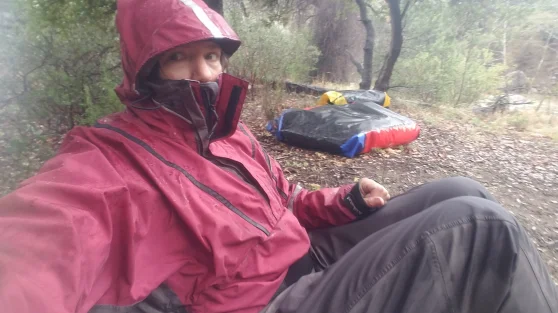
Finally about 10am I could see some blue sucker holes opening up in the clouds above. Blue sky never looked so good! Slowly some folks started to leave their shelters, and more and more blue appeared overhead. WOOOhooo!
We all shared stories of our panic at floating away during the night.
When enough of the sky had cleared, folks started packing up.
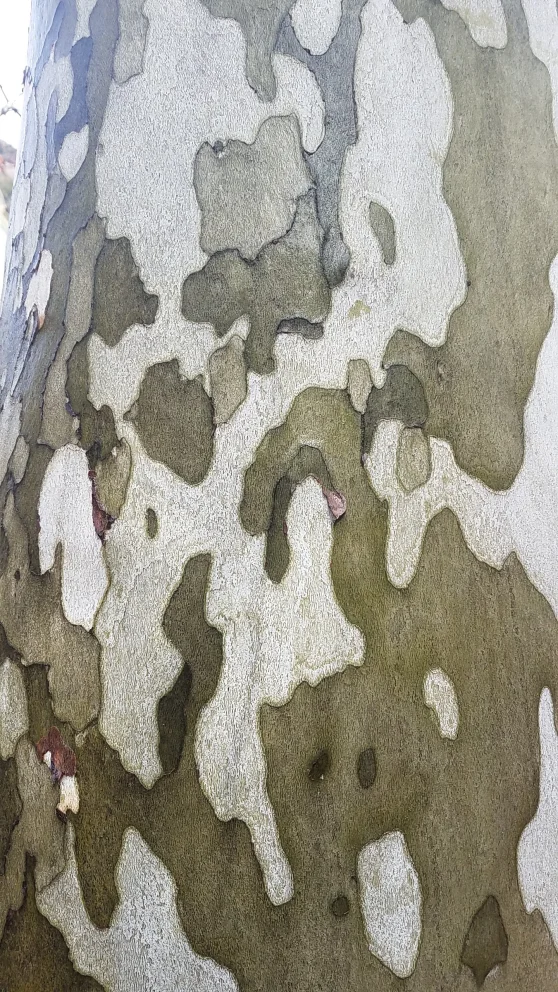
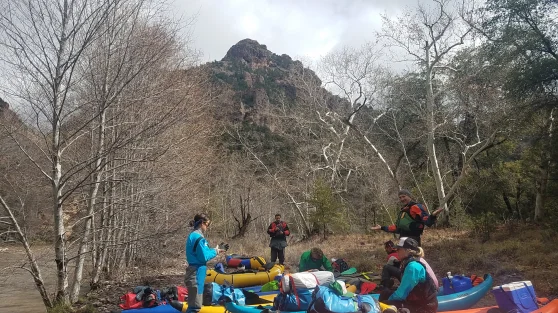
We launch for the final day of paddling just shy of noon; we had definitely made the right call to wait out the rain, for the sun came back, and with it warmth and spring.
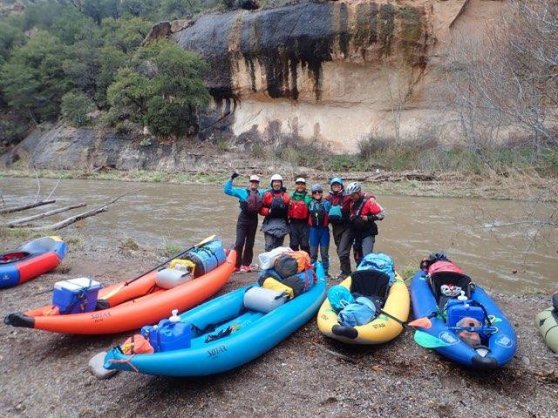
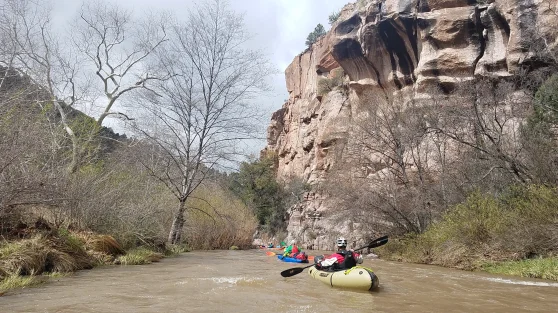
The trees were practically blossoming before our eyes, the fragrance hung in the air.
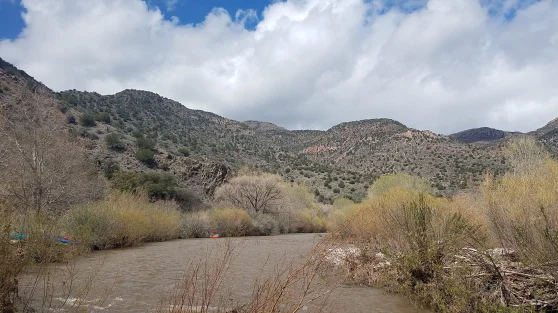
We had a fun little rapid that some folks decided to run, others portaged.
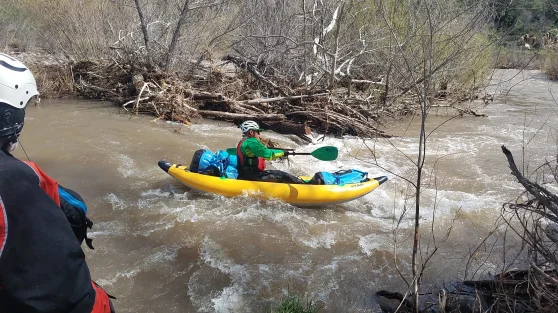
By day 5 we were all paddling much more in sync. In fact, we looked like a line of ducklings following Kirk down the river.
The nine miles passed fairly quickly, and we enjoyed the freshly washed canyon walls.
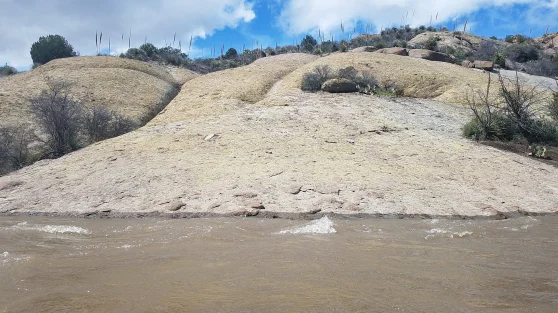
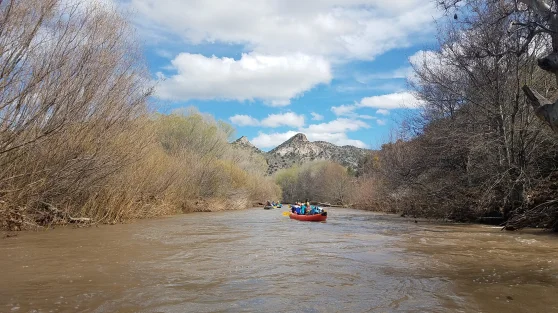
By mid afternoon the river corridor had flattened out, and we could see that we were leaving the mountains behind.
A river gauge marked our progress, two more miles to where our cars should have been parked at the take out.
Then, the cars.
By this point it was warm and sunny, it was a beautiful day.
We opened beers, toasted to a fabulous river trip, packed up the cars, and went to find out what had happened to the world.
Kirks’ story of getting caught in a historical flood was seared into our brains as we listened to the rain dump and dump and dump.
Then, it stopped.
Suddenly there was no more rain, no more wind…just an erie silence in the middle of the night. Ok sleep, now I guess is the time.
The night was quiet, the early morning was quiet, and just about the time I thought about getting up it started to rain again. Really?!?!
I got out of the tent to have a look around, someone had gotten up in the night and pulled the boats up higher. I checked the stick, and to my surprise saw the water had only risen about an inch. Note: a great way to gauge water levels is to push a stick into the ground at the point where the water meets the shore. Later you can use the stick as a reference point to see if the water has gone up or down in level since your arrival.
No way all that rain fell and the water only rose an inch! One possibility was snow…we had heard that this weather in the higher elevations might be falling as snow. Regardless of the reason, we hadn’t floated away, we hadn’t lost the boats. We were still here, and it was still raining.
In fact, it was raining hard again.
I returned to the tent and made coffee from inside, trying not to burn the vestibule of the tent as I fired up the stove just outside the door. I got a new weather report from the InReach to find out what I could already see: rain. BUT the chances dropped by about 10am, lower by noon, and by 2pm there was a sun icon. YES!
But now it was pouring.
Kirk and I started to pack up what we could inside the tent, and then we put on all of our boating gear: dry pants and top, and started putzing around outside the tent. I sat under a tree in full gear, watching and waiting. No one else had emerged.
Finally about 10am I could see some blue sucker holes opening up in the clouds above. Blue sky never looked so good! Slowly some folks started to leave their shelters, and more and more blue appeared overhead. WOOOhooo!
We all shared stories of our panic at floating away during the night.
When enough of the sky had cleared, folks started packing up.
We launch for the final day of paddling just shy of noon; we had definitely made the right call to wait out the rain, for the sun came back, and with it warmth and spring.
The trees were practically blossoming before our eyes, the fragrance hung in the air.
We had a fun little rapid that some folks decided to run, others portaged.
By day 5 we were all paddling much more in sync. In fact, we looked like a line of ducklings following Kirk down the river.
The nine miles passed fairly quickly, and we enjoyed the freshly washed canyon walls.
By mid afternoon the river corridor had flattened out, and we could see that we were leaving the mountains behind.
A river gauge marked our progress, two more miles to where our cars should have been parked at the take out.
Then, the cars.
By this point it was warm and sunny, it was a beautiful day.
We opened beers, toasted to a fabulous river trip, packed up the cars, and went to find out what had happened to the world.
Gila River Day 4

To go or not to go? That was the question.
The morning’s weather report again mentioned temps in the 40s, and 70% chance of rain in the afternoon and evening. Tomorrow, however, was looking drier.
When I emerged from the tent I saw Slow Ride was up and about. I went over to our morning fire and made coffee. Other folks started to trickle out of their warm dry places, but it was clear we were on a slower mode than yesterday (remember that 10:30am start??).
We started talking exit strategy. If we packed up and paddled, we would be paddling in cold wet conditions…again some folks were already cold and wet, so this option could be extremely uncomfortable, but we’d get to the cars today (we had about 9 miles left to paddle), and then be dry! Who cares if we are hypothermic if we can get to dry! So that was option 1.
Option 2 involved packing up and paddling 2 more river miles, and setting up camp again…because there were some amazing hot springs a 3-5 mile hike up a side creek from the Gila River. That sounded attractive cause who doesn’t like soaking in a hot springs when it’s pouring rain? BUT breaking down camp and setting up camp again would be a MAJOR drag. And the hike was rumored to be long and frustrating.
Option 3: stay where we were and have a layover day; continue down the river and to the cars tomorrow. Hmmmmm…
We went round and round with our choices, everyone not committing and hoping someone else would make the decision.
Where did we have to be? There was a pandemic outside. The minute we turned our phones on again we would be faced with a changed world. Did we really want to rush that? But cold and wet…but dry cars…but…
Soon it was apparent that we had waffled long enough that we’d be lucky to pack up and get on the river by noon when the rain was supposed to start. I guess we made our decision by not making a decision.
Alright! Layover day!
Turns out we all brought books, games, podcasts, snacks, music…items we haven’t really been able to enjoy all that much since we have been spending so much time on the river. We had all packed for a layover day, and just didn’t know it 🙂
Slow Ride got out his maps (he had some beautiful topo maps made especially for the trip), and we geeked out over the contour lines…figuring now we had time to do some exploring.
So many places to go! So many places to see!
We decided to take a hike up to the high point behind camp. Kirk and I found creative ways to turn dry bags into fanny packs/backpacks, and we took off with Slow Ride and Mike.


Most of the way up the climb we saw that JJ and Mika had beat us to it, and were hooting and hollering from the rocky outcropping above us.

We made our way up to the top of the world, and looked out over the vastness.


The Gila is an incredible huge tract of wilderness. I had been reading in Slow Ride’s book, Gila Libre, about the previous native tribes, trappers, mountain men, and outlaws that had made this river drainage their home for hundreds and thousands of years. We were not the first, and would not be the last. But for all those people who have walked the banks of the river, very little trace is left. This area was trapped heavily for beaver and other large game when things like fur hats were all the fashion, but I was heartened to see a ton of beaver activity all along the shores we had paddled the last few days. Some things can recover.


Photo by Slow Ride (he has long arms…perfect for a group selfie!)
The first few drops of rain fell on us as we enjoyed the views, and that was our cue to start hiking back to camp.

By the time we made it down, it was time to dive into the tents. I picked up the Gila book and proceeded to finish it that afternoon. We napped, we snacked. Kirk and I played rounds of UNO. We napped and snacked again. The rain was not letting up, but finally we decided to go on a little walk just for something to do. We had waterproof gear anyway!
We walked upstream looking for cool rocks on the flood planes. We walked down stream, finding some overhangs where we could take shelter from the constant rain. The others emerged from their tents for the same reasons here and there, but we all returned to escape the pouring water.
About dinner time the rain seemed to let up a little. Woooohooo! We all left the tents, and were actually able to get a big fire going despite all the wet wood. We had just enough time to make and eat dinner before the deluge started again. Kirk was able to tell us his story of getting stuck on the John Day River last April in the second highest recorded flood in history. He spent four days in place waiting for the full sized trees that had filled the water-way to clear (the river had gone from 10,000 cfs when he launched, to 39,000 cfs). Unbeknownst to him, he was the only one on the river, and search parties had been sent out looking for him….just in case he was in trouble. Well, the story ended well. He was safe, he had to almost rescue the rescuers, and now has quite a story to tell.
In retrospect, maybe telling the story before a massive rainstorm that sounded like a freight train driving through camp wasn’t a great idea. Flash floods on a desert river and all…
Gila River Day 3

Now that I’m home, I am learning more and more about the Gila River and efforts to protect it as a Wild and Scenic River. Read more here
Now, back to the river!
Day 3:
We didn’t make the miles yesterday that we wanted. We had over 40 miles to go on the trip, and there was the added wildcard of rain and potentially snow in the forecast soon. Our options were to paddle fast and get out before the weather, or slow down and keep on despite the weather. Because some of our crew didn’t have dry suits and were already somewhat cold and wet during the day, we had to consider the dangers of paddling all day in wet clothes and 40 degree temps. So far we had had blissful sun during the day which not only helped moral, but helped keep everyone warm.
So today’s goal would be to get an early start (earlier than noonish), and move down the river. We were on the water by 10:30 (success!!) and doing a bit more paddling all around.
The water levels have continued to drop, and with it the speed of the moving water. But we were making awesome time, and after the first hour in our boats, had already gone 5 miles.

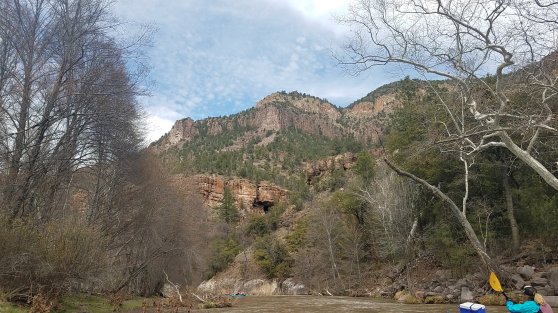
We continued on, and if it was possible for the river canyon to get even more beautiful, it did. We were paddling past more dramatic rock walls, and since we were dropping in elevation every day, the signs of spring seems to intensify over the miles. We also spied caves in the canyon, caves that might have housed people for thousands of years.
We are, as JJ calls it, epicing.


We had lunch on a rocky beach. Oh yeah! It was St. Patrick’s day! As a Patrick I felt it was my duty to pass around some whisky during the break, and we all practiced safe flasking by pouring it into our mouths from a safe distance.
We kept on moving down the river that afternoon, had one tree we needed to limbo (duck down to avoid smashing our face into it) but everyone made it through unscathed.
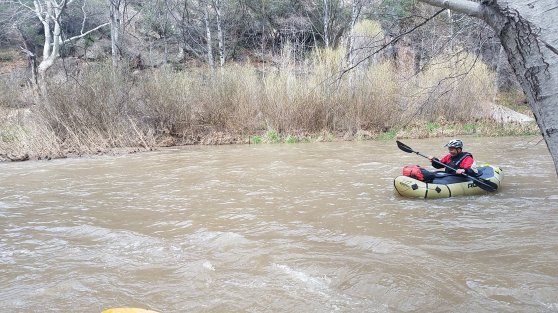
Mike’s turn at the limbo tree

By the time it started to cloud up, we found a nice big flat to make camp. The rain and cold were due to start the next day. I was carrying an InReach beacon, which offers a way to get a weather report. We checked it and saw the rain was due to start late morning tomorrow. So we did the only logical thing and decided to decide our next move in the morning.


There was a fire to make, and some chillaxing to be done.
Gila Day 2

Group photos by Slow Ride


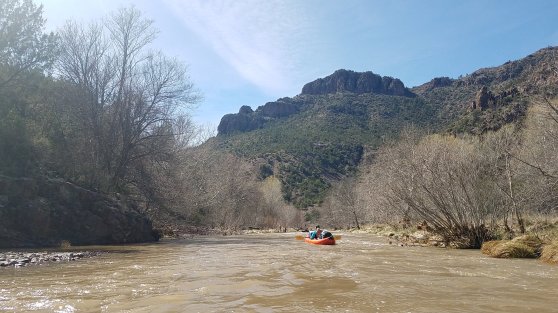
For all of our effort, we didn’t seem to be moving efficiently down the river. We had a few swims, but all people and gear were recovered, and even though a few folks were shaken up from the cold immersion, we all rallied and kept going.The water at this level kept us busy, and the previous flooding had left tons of strainers in the water. Granted, most of these strainers didn’t span the width of the river, so we were able to paddle by them, however, they could be a real problem if you floated into them wrong.
We saw one other group on the river today, a group of three, each in their own cataraft. Those were ambitious boats because we encountered tons of low-hanging branches that surely resulted in tree branch slaps in the face as those boats sit much higher in the water.
At the end of the day, we rounded a corner to find them portaging a river-wide tree blocking the way, and so we did the same.
We hadn’t made the mileage we had wanted, but our safety and enjoyment were more important, so we pulled up at Sapillo Creek to make camp. This is where (I think) I came down on the CDT five years ago and started walking upstream. I guess we just did a paddle alternate to the hiking route!
We spread out and put on dry clothes. The water in the creek was much cleaner than the Gila, so that would be a good option for filtering, but then we discovered a little waterfall that had even cleaner water. Score!


Then it was time for happy hour on the beach. I passed out cans of Greyhound, a mixed cocktail drink made by a brewery in Bend. We sat on boats and watched the sun go down before retiring to the fire and our dehydrated/freeze-dried meals.


Another warm night, exciting!
Gila River Day 1
I was almost warm enough last night. My thick inflatable bargin
sleeping pad was only thick enough if I lay my whole body evenly on the
pad…curling into my usual side position dipped my hip to the ground, and
that ground sucked the warmth out of me.
When we did finally emerge outside the tents everything was covered in frost and ice. Brrrr. Our friends were warm blooded and were not excited by the frosty morning warning.

Eventually the sun hit camp, and made the duffle shuffle go a little faster. How would we possibly fit all the food, beer and gear into our little boats? The inflatable kayak folks had a much easier time as they can strap just about anything to the tops of their long boats. We packrafters have to fit it inside our boats, or smartly strapped to the outside. Mike was in the other packraft, and this would be his first overnight trip in his craft.
Somehow we were packed and almost ready to go when our shuttle driver came and gave us some useful beta on the river (he had just paddled it a few weeks before) but the spike in the river level after the heavy rains of the days before would provide a wild card. Would the flows have lodged some trees across the river? New strainers, log jams or hazard trees? We all got a safety talk from Kirk who has taught, guided, and explored flooded rivers like this for years. We are in good hands with Kirk at the helm.
The water was a chocolate brown, but not thick with dirt and mud. The brunt of the flooding was over and the water levels were going down now. We paddled past cliffs and treed flats, noticing where the water had crested in a much bigger flood. Folks were getting used to their boats, and we had clear sailing for the whole day.


Numerous cairns marked where a trail crossed the river back and forth, and Slow Ride, Shake n Bake and myself were pretty sure we had hiked some of this on the CDT gila alternate years before…and I could even have sworn that I had a cold wet camp at this very spot 5 years ago on my thru-hike. I’ll have to go back and check my blog; my camp at this spot ended with a windy sleepless night on the river….I woke to snow and high tailed it to Doc Campbell’s that next morning with promise of a food box and the stellar Gila Hot Springs.


Our afternoon at camp consisted of a few lazy hours in the sun in hammocks or laid out horizontal in some fashion. Slow Ride lent me a book about the Gila river, so I read a few pages before closing my eyes too.
Later around the campfire we passed bags of wine and told stories.

The night was clear and blissfully warm.
When we did finally emerge outside the tents everything was covered in frost and ice. Brrrr. Our friends were warm blooded and were not excited by the frosty morning warning.
Eventually the sun hit camp, and made the duffle shuffle go a little faster. How would we possibly fit all the food, beer and gear into our little boats? The inflatable kayak folks had a much easier time as they can strap just about anything to the tops of their long boats. We packrafters have to fit it inside our boats, or smartly strapped to the outside. Mike was in the other packraft, and this would be his first overnight trip in his craft.
Somehow we were packed and almost ready to go when our shuttle driver came and gave us some useful beta on the river (he had just paddled it a few weeks before) but the spike in the river level after the heavy rains of the days before would provide a wild card. Would the flows have lodged some trees across the river? New strainers, log jams or hazard trees? We all got a safety talk from Kirk who has taught, guided, and explored flooded rivers like this for years. We are in good hands with Kirk at the helm.
The water was a chocolate brown, but not thick with dirt and mud. The brunt of the flooding was over and the water levels were going down now. We paddled past cliffs and treed flats, noticing where the water had crested in a much bigger flood. Folks were getting used to their boats, and we had clear sailing for the whole day.
Numerous cairns marked where a trail crossed the river back and forth, and Slow Ride, Shake n Bake and myself were pretty sure we had hiked some of this on the CDT gila alternate years before…and I could even have sworn that I had a cold wet camp at this very spot 5 years ago on my thru-hike. I’ll have to go back and check my blog; my camp at this spot ended with a windy sleepless night on the river….I woke to snow and high tailed it to Doc Campbell’s that next morning with promise of a food box and the stellar Gila Hot Springs.
Our afternoon at camp consisted of a few lazy hours in the sun in hammocks or laid out horizontal in some fashion. Slow Ride lent me a book about the Gila river, so I read a few pages before closing my eyes too.
Later around the campfire we passed bags of wine and told stories.
The night was clear and blissfully warm.
Subscribe to:
Posts
(
Atom
)